
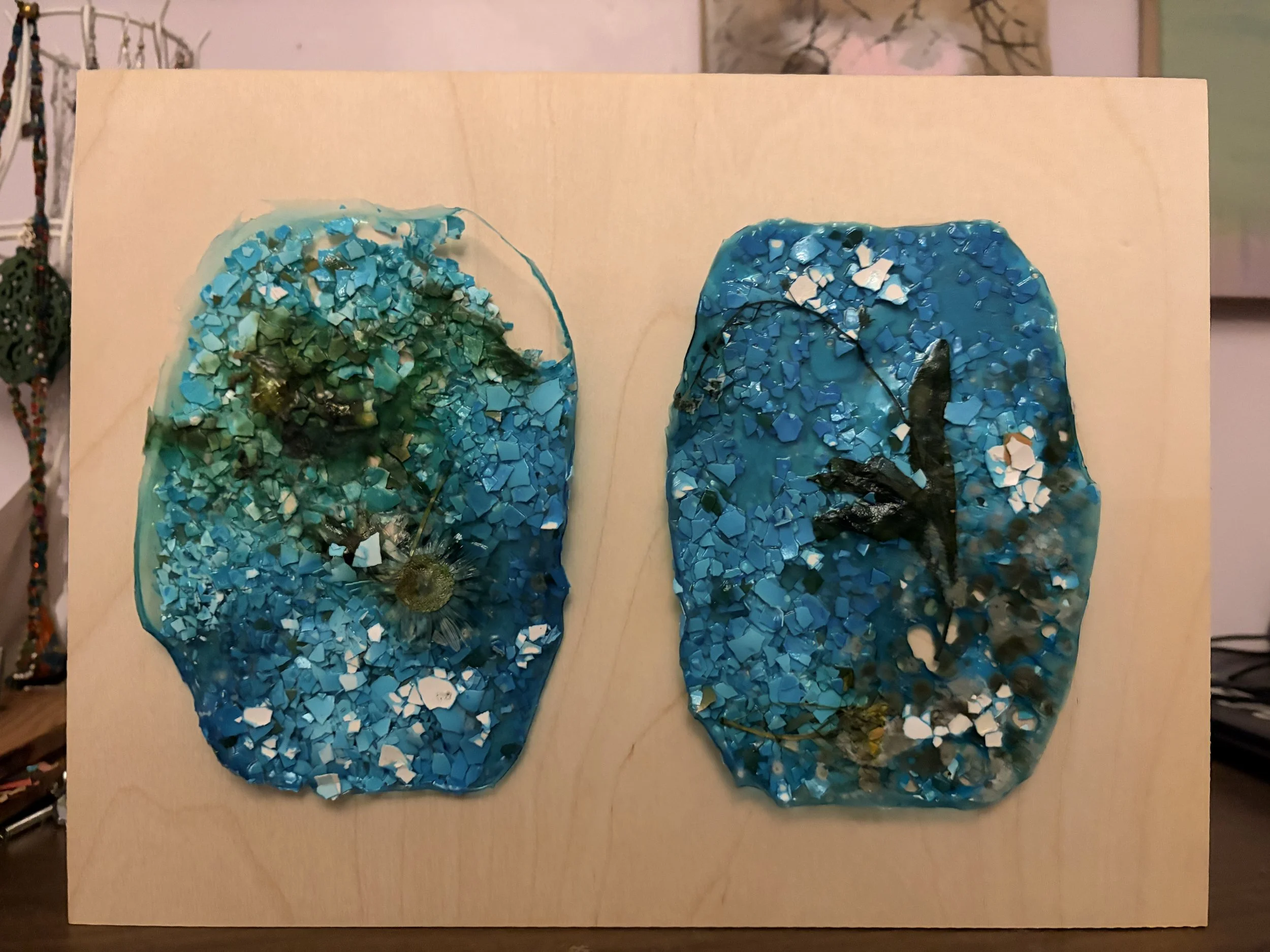
Isa Michaud, Respire à fond (espace pleural), 9” x 12”, glicérine et gélatine sur bois, 2026. Piece faisant partie de l’installation “La mère et la fille” incluant la projection d’un court film.
Espace pleural / Respire à fond
Isabelle Michaud
Sault Ste-Marie
Espace Pleural / Respire à fond est une recherche exploratoire sur le thème de la respiration, de la physiologie du poumon, son rapport aux plantes, et à l’air que nous respirons. Un geste si simple mais qui est en lien avec la nature et le corps de l’artiste qui est pressenti par les matériaux fibreux et l’aspect sensoriel estompé accompli par la gélification des plantes dans le plastique et la réflexion des films sur les oeuvres. Parfois jumelées, parfois entrant en contact directement avec elles, les images se fusionnent avec les membranes créées par la gélatine et la glycérine. Elles-mêmes une sorte de membrane illuminée, les images des courts films servent de miroir et de portail vers des émotions de perte, de deuil, d’écoanxiété, mais aussi de douceur. La nature faisant partie intégrante de ce travail passager et éphémère, ces oeuvres ne laisseront pas beaucoup de traces une fois désintégrées et retournées à la nature elles-mêmes.
Des photographies de ma famille parsèment le travail, mes deux parents ayant tous les deux succombés à des troubles de la respiration.
L’organe respiratoire est enveloppé par une fine membrane appelée espace pleural, j’ai retenu ce terme car il a deux sens, le sens de “pleurer” et le sens de “pleural” relié aux poumons et à la respiration. En anglais, cette membrane se nomme “pleura.” Elle est composée de deux membranes en fait, une qui ne ressent pas, la viscérale, qui n’est pas couverte de nerfs et l’autre qui l’est, et qui s’appelle pariétale. Dans ce travail, qui est plutôt conceptuel, se retrouve des formes forcées et forgées, et des formes naturelles. J’ai travaillé avec ces deux forces au travers du travail, en laissant le plus de naturel aux formes et aux processus.
Cette exploration me fait ressentir de l’empathie pour mes parents que j’ai perdus tous les deux, dû à des maladies reliées à la respiration. Une sorte de Jenga médical a suivi leurs derniers moments. La conscience de la respiration et de combien chacune des respirations que je prends est précieuse marque les œuvres.
En marchant dans la forêt, j’inspire l’air que les arbres ont créé et je deviens une partie d’eux en même temps. Je les invite dans mon corps.
With each breath, I exhale the waste.
BREATHE IN - BREATHE OUT.
and again, I take in the oxygen that allows me to live, work, create, sing,
laugh.
Last February, I listened to the words of BHiKKHU Pañnăkára, a Buddhist monk,
He talked about the importance of breathing deeply and intentionally and saying the words:
« Today will be my peaceful day.»
La respiration aide à se recentrer.
Un geste si simple.
RESPiRE INSPiRE
EXPiRE
INSPiRE
EXPiRE
Regarde les fleurs et les petites tiges, de couleur cuivrée
Sur la membrane de la vie....
During the covid-19 Pandemic, I was so scared. I had never experienced that level of fear. Breathing became so important to me. I was thankful for each breath.
L’installation “Au Service des femmes” explore mon histoire personnelle familiale, mon rapport à ma mère et à mon deuil de sa perte. J’avais passé une dernière nuit dans son lit en regardant un clou au mur que quelques mois auparavant, j’avais planté là, pour y accrocher une oeuvre que ma mère adorait. Cette dernière nuit s’est traduite ainsi par ces oeuvres sur des vieux draps de lit recyclés et brodés, sérigraphiés et imprimés à l’encre de chou. Le film “Au service des femmes” est en lien avec la vie de ma mère qui a travaillé pour le développement professionnel des femmes monoparentales. La photo d’elle et de ses soeurs est un miroir de mes soeurs et moi, ses quatre filles. Les cycles familiaux refaits dans chaque génération. Il y a probablement eu une Noëlla Guimond dans les années 1600, 1700, 1800, une femme qui était un peu différente et qui forgeait devant elle, en luttant pour les autres, avec compassion.
L’installation “Fleuve” est une sorte de funérail pour ma mère, un rectangle contenant de l’eau du fleuve et de la rivière Sainte-Marie, se trouve au centre de la dernière image de son appartement, où j’ai laissé le dernier endroit qui était encore en lien de son vivant. Quitter ce dernier appartement et éparpiller ses cendres sur le fleuve Saint-Laurent ont été les derniers gestes que j’ai posés encore reliés à sa personne physique. Maintenant, elle vit avec moiet m’accompagne dans mon travail. Trois ou deux poumons l’accompagnent, agissant en gardiennes témoignant de son passage au fleuve des atomes.
L’installation “La Tasse” fait référence au thème de “dormir alors que le monde brûle.” Ces éléments sont encore une fois un retour sur ma mère, sur le bioplastique, la membrane respiratoire qui est posée sur fond de fibre, la fibre des plantes qui nous permettent de respirer. Ces cycles de vie et de mort imbriqués l’un dans l’autre, inesquivables. J’ai gravé une image où je dormais dans le lit de ma mère, cette dernière nuit, où je lui ai dit adieu pour toujours, un mois après sa mort. Mon visage y apparaît dormant. Les dernières traces de son appartement toujours présentes et un peu accusatrices “tu aurais dû passer plus souvent.”
L’installation “Night Fire” rassemble des oeuvres de bioplastique et papier de fibre de plantes, sur panneau de bois, ainsi qu’un film dans lequel se retrouvent des images de la Californie, les incendies de la Palissade, et des images du Lac Supérieur. Afin de signifier qu’il faut faire attention au réchauffement climatique et travailler fort pour faire plus de gestes qui sont bons pour l’environnement. Car sans la terre, nous n’avons rien. Sans l’eau et l’air, nous ne pouvons pas vivre. L’idée de “dormir alors que le monde brûle” se retrouve dans ce travail encore une fois. Deux événements catastrophiques, la perte de ma mère et les incendies en Californie, s’entrecroisant, et se juxtaposant l’un sur l’autre en donnant un sentiment de douceur, oui, mais dans lequel se trouve une tension par les détails qu’on remarque: les images d’incendie, le noir de l’encre, les mots “Baignées d’étoiles” pour signifier la fin de la vie.
La murale “déracinements recomposés”assemble des objets naturels et fabriqués, la fibre d’alpaga filée avec Mireille Gagnon-Moes se retrouve crochetée sur une feuille pressée de vigne sauvage qui pousse dans le jardin en arrière, ma cour. Cet assemblage s’ajoute à une dizaine d’autres éléments, du papier artisanal, des découpures dans de l’aluminium de canettes de boissons gazéifiées, des petites photos photocopiées de moi quand j’étais petite fille pointant du doigt, “Miss Sassy pants.” Des racines et des plantes de tomates séchées, cueillies avant le gel, et gardées pour les assembler au mur plus tard dans cette fresque racontant un peu une sorte de ligne de temps de la vie d’une personne. Déracinements recomposés raconte un peu ma vie d’artiste dans une série d’objets assemblés et diposés horizontalement. J’ai déménagé plusieurs fois et me suis reconstituée et recomposée plusieurs fois au cours de ma vie.
Cap-Rouge est l’histoire de ma jeunesse. Du bioplastique séché sur un couvercle de Rubbermaid ayant créé une cavité ovale au centre, parfaite pour une sorte de cadre naturel, est collé sur un papier vert plante. J’ai écrit des souvenirs de ma jeunesse sur Cap-Rouge à la mine, en anglais afin que le spectateur puisse comprendre. Voici le texte.
"My life, as a child was spent in and around our blue house in Cap-Rouge, Quebec, Canada, imagining and playing under the «galerie», the back deck, that my father built. It was spent planting plants and seeds with my mother, walking in the fields in front of my house where we would disappear making paths and pretend "houses" in the tall grass. Building tunnels, and sliding down hills in the winter. The spring brought amazing puddles that I thought were great, big lakes in which I walked with my rubber boots, drowning my Barbies in those ponds. I cried upon finding dead birds and gave them funerals. I fell off the «tremble» tree behind my house and felt my breath completely cut «le souffle coupé.» I climbed ladders that my dad left when he would work on the roof and I chased butterflies completely oblivious of the danger. This rural setting shaped me -- I could hear «Les carillons des cloches de l'église du village.» It gave me a taste for creating experiences with physical objects and moving images and projections. It reminds me to breathe with nature and allow its beauty and goodness to enter my body allowed by the thin «pleural membrane» in my lungs with cellular regeneration. Being a part of each other through our breathing processes. Today in my 50s when I make a bioplastic or a paper with plants from my backyard, it's always to this Cap-Rouge setting that I return. To my parents and my three sisters and my own little family, all into one time in space through this work."
“La respiration aide à se recentrer” est une exploration sur le sang. Du bioplastique a été coulé dans des assiettes afin de ramener l’aspect domestique de mon travail, la broderie, le traitement de la gélatine, la fabrication du papier, le jardinage, le pressage des fleurs, le filage, toutes ces formes d’activités domestiques ont souvent été associées au personnage de la vieille femme que je suis en train de devenir. J’ai réécrit des extraits que ma mère a écrit dans des cachiers. Des extraits qui ne seraient pas nécessairement identifiables qui sont un peu retirés de leurs contextes. J’ai écrit ces extraits sur des notes de calepin de papier que ma mère avait et quand elle est décédée ma soeur m’a donné tous ces calepins et bloc-notes. J’ai laissé sécher le bioplastique avec ces notes à l’intérieur et avec des plantes pour les entourer. J’ai choisi un rouge sang qui se traduit très bien. J’ai créé le film pour les accompagner. Un film qui se réfère au travail lui-même et qui crée une composition unifiée. J’ai filmé les cercles rouges et reprojeté ces scènes d’elles-mêmes sur les 4 cercles, disposés comme 4 cellules de sang, en ligne horizontale.
“La mère (mer) et la fille” est une exploration des poumons représentés par les deux formes de bioplastique sur les panneaux de bois. Des photos de ma mère et de moi surplombe le travail de film projeté sur les deux panneaux qui sont comme des parenthèses de chaque côté de la projection. Le film s’harmonise de mieux en mieux avec les oeuvres. Le travail de film et de création d’objet physiques se fait de mieux en mieux et porte de plus en plus de sens. J’espère continuer dans ce sens maintenant. Cette exploration a mené à déboucher sur un processus important de création.
English version
Pleural space / Take a deep breath
Isabelle Michaud
Sault Ste. Marie
Pleural space / Breathe deeplyThis is an exploratory research project on the theme of respiration, lung physiology, its relationship to plants, and the air we breathe. A gesture so simple, yet connected to nature and the artist's body, suggested by the fibrous materials and the blurred sensory aspect achieved by the gelling of plants in plastic and the reflection of films on the artworks. Sometimes paired, sometimes coming into direct contact with them, the images merge with the membranes created by the gelatin and glycerin. Themselves a kind of illuminated membrane, the images of the short films serve as a mirror and a portal to emotions of loss, grief, eco-anxiety, but also gentleness. Nature being an integral part of this fleeting and ephemeral work, these pieces will leave little trace once they disintegrate and return to nature.
Photographs of my family are scattered throughout the work, as both my parents succumbed to respiratory problems.
The respiratory organ is enveloped by a thin membrane calledpleural spaceI chose this term because it has two meanings: "to cry" and "pleural," referring to the lungs and respiration. In English, this membrane is called the "pleura." It is actually composed of two membranes: one that is insensitive, the visceral membrane, which is not covered in nerves, and the other that is, called the parietal membrane. This work, which is rather conceptual, incorporates both forced and forged forms, as well as natural forms. I worked with these two forces throughout the piece, allowing as much naturalness as possible to the forms and processes.
This exploration evokes empathy for my parents, both of whom I lost to respiratory illnesses. A kind of medical Jenga followed their final moments. The awareness of breath, and how precious each breath I take is, permeates my work.
Walking in the forest, I breathe in the air that the trees have created and I become a part of them at the same time. I invite them into my body.
With each breath, I exhale the waste.
BREATHE IN - BREATHE OUT.
and again, I take in the oxygen that allows me to live, work, create, sing,
laugh.
Last February, I listened to the words of BHiKKHU Pañnăkára, a Buddhist monk,
He talked about the importance of breathing deeply and intentionally and saying the words:
« Today will be my peaceful day.»
Breathing helps to refocus.
A simple gesture.
BREATHE INSPIRE
EXPiRE
INSPiRE
EXPiRE
Look at the flowers and the small stems, which are coppery in color.
On the membrane of life....
During the covid-19 Pandemic, I was so scared. I had never experienced that level of fear. Breathing became so important to me. I was thankful for each breath.
The installation “In Service to Women” explores my personal family history, my relationship with my mother, and my grief over her loss. I spent one last night in her bed, staring at a nail on the wall that I had hammered in a few months earlier to hang a piece my mother adored. That last night resulted in these works on recycled bed sheets, embroidered, screen-printed, and printed with cabbage ink. The film “In Service to Women” is connected to my mother’s life; she worked in the professional development of single mothers. The photograph of her and her sisters is a mirror to my sisters and me, her four daughters. Family cycles repeated in each generation. There was probably a Noëlla Guimond in the 1600s, 1700s, or 1800s, a woman who was a little different and who forged ahead, fighting for others with compassion.
The installation “River” is a kind of funeral for my mother. A rectangle containing water from the St. Lawrence River and the Sainte-Marie River sits at the center of the last image of her apartment, where I left the last place that still connected me to her while she was alive. Leaving that last apartment and scattering her ashes on the St. Lawrence River were the last acts I performed that were still connected to her physical being. Now, she lives with me and accompanies me in my work. Three or two lungs accompany her, acting as guardians, bearing witness to her passage into the river of atoms.
The installation “The Cup” refers to the theme of “sleeping while the world burns.” These elements are yet another reflection on my mother, on bioplastic, the respiratory membrane placed against a background of fiber, the plant fiber that allows us to breathe. These cycles of life and death are intertwined, inescapable. I engraved an image of myself sleeping in my mother’s bed, that last night, when I said goodbye to her forever, a month after her death. My face appears asleep. The last traces of her apartment are still present and somewhat accusatory: “You should have come by more often.”
L’installation “Night Fire”This work brings together works made of bioplastic and plant fiber paper on wood panels, as well as a film featuring images of California, the Palisade fires, and images of Lake Superior. Its purpose is to emphasize the need to be mindful of climate change and to work diligently to adopt more environmentally friendly practices. For without the earth, we have nothing. Without water and air, we cannot live. The idea of "sleeping while the world burns" is present once again in this work. Two catastrophic events, the loss of my mother and the California fires, intertwine and are juxtaposed, creating a sense of gentleness, yes, but one that also contains a tension through the details we notice: the images of fire, the black ink, the words "Battered by Stars" signifying the end of life.
The mural “Recomposed Uprootings” assembles natural and manufactured objects. Alpaca fiber spun with Mireille Gagnon-Moes is crocheted onto a pressed leaf of wild vine that grows in the back garden, my yard. This assemblage is added to about ten other elements: handmade paper, cutouts from the aluminum of soda cans, small photocopied photos of me as a little girl pointing, “Miss Sassy Pants.” Dried tomato roots and plants, picked before the frost and kept to be assembled on the wall later in this mural, tell a kind of timeline of a person’s life.Uprooted and RecomposedIt tells a bit about my life as an artist in a series of objects assembled and arranged horizontally. I have moved several times and have rebuilt and recomposed myself several times throughout my life.
Cap-Rouge is the story of my youth. Bioplastic dried on a Rubbermaid lid, creating an oval cavity in the center—perfect for a sort of natural frame—is glued onto plant-green paper. I wrote down memories of my youth about Cap-Rouge in pencil, in English, so the viewer could understand. Here is the text.
"My life, as a child was spent in and around our blue house in Cap-Rouge, Quebec, Canada, imagining and playing under the «galerie», the back deck, that my father built. It was spent planting plants and seeds with my mother, walking in the fields in front of my house where we would disappear making paths and pretend "houses" in the tall grass. Building tunnels, and sliding down hills in the winter. The spring brought amazing puddles that I thought were great, big lakes in which I walked with my rubber boots, drowning my Barbies in those ponds. I cried upon finding dead birds and gave them funerals. I fell off the «tremble» tree behind my house and felt my breath completely cut «le souffle coupé.» I climbed ladders that my dad left when he would work on the roof and I chased butterflies completely oblivious of the danger. This rural setting shaped me -- I could hear «Les carillons des cloches de l'église du village.» It gave me a taste for creating experiences with physical objects and moving images and projections. It reminds me to breathe with nature and allow its beauty and goodness to enter my body allowed by the thin «pleural membrane» in my lungs with cellular regeneration. Being a part of each other through our breathing processes. Today in my 50s when I make a bioplastic or a paper with plants from my backyard, it's always to this Cap-Rouge setting that I return. To my parents and my three sisters and my own little family, all into one time in space through this work."
“Breathing Helps You Refocus” is an exploration of blood. Bioplastic was poured into plates to bring back the domestic aspect of my work: embroidery, gelatin processing, papermaking, gardening, flower pressing, spinning—all these forms of domestic activity have often been associated with the character of the old woman I am becoming. I rewrote excerpts that my mother had written in notebooks. Excerpts that wouldn't necessarily be identifiable, somewhat removed from their original context. I wrote these excerpts on notes from a notebook my mother had, and when she passed away, my sister gave me all of these notebooks and notepads. I let the bioplastic dry with these notes inside and with plants surrounding them. I chose a blood red, which translates very well. I created the film to accompany them—a film that refers to the work itself and creates a unified composition. I filmed the red circles and reprojected these scenes of themselves onto the 4 circles, arranged like 4 blood cells, in a horizontal line.
“Mother (Sea) and Daughter” is an exploration of lungs, represented by two bioplastic forms on wooden panels. Photographs of my mother and me are superimposed on the film projected onto the two panels, which act like parentheses on either side of the projection. The film is becoming increasingly harmonious with the artworks. The filmmaking and physical object creation process is improving and taking on more and more meaning. I hope to continue in this direction. This exploration has led to a significant creative process.